Maison Cendre
The Wife He Threw Away: A Billionaire Secret Baby, Marriage-in-Crisis, Second-Chance Grovel RomanceMaison Cendre is Ada Hart’s answer to the theft of Éternel: a Paris perfume house created after Vale Group publicly assigned her work to Chloe Beaumont and reduced Ada, in her husband Sebastian Vale’s words, to a chemist whose name could not sell a four-hundred-million-dollar brand. Founded during Ada’s pregnancy and separation, Maison Cendre transforms betrayal into a business whose central principle is that the creator’s name, formulas, and authority must remain attached to the work. Its later merger with Vale Group becomes possible only when that principle is made permanent in governance, public credit, and control.
Foundation and Ash Philosophy
Maison Cendre begins in the months after the Éternel launch gala, when Ada leaves Sebastian and rebuilds her life in Paris. While her waist thickens during pregnancy, she and Estelle lease a narrow shopfront on the Rue des Cendres, paint it grey, and hang a single-word sign. The location and name are deliberate: Ada chooses Cendre, meaning ash, as a record of the ruined year and of what remains after sweetness, illusion, and self-deception have burned away. Maison Cendre’s founding philosophy is therefore not decorative branding. Ada defines ash as what fire could not take, the surviving substance left after the pretty surface and the lie told in the Grasse jasmine fields have been destroyed. The name gives the company a material and ethical vocabulary: endurance is more valuable than inherited glamour, and survival must be made visible rather than concealed beneath a polished story.
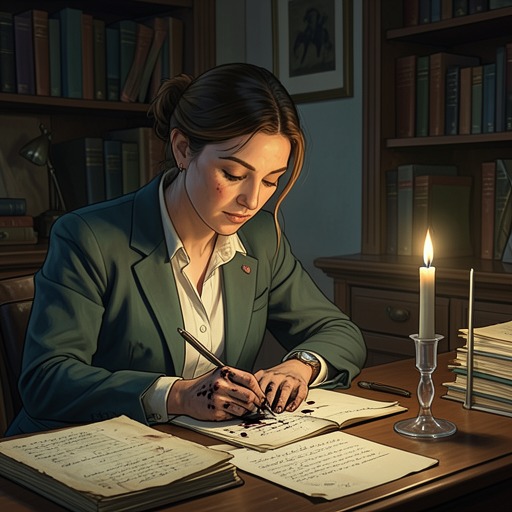
The house is built with Estelle’s help. Estelle gives Ada her old two-hundred-tier perfume organ, the instrument on which she had developed her early work, and tells Ada only to finish what they began. Ada eventually expands the organ to three hundred essences, each keyed in her own hand. Unlike the hidden laboratory that once protected Ada’s work through a private thumbprint lock, the Maison Cendre atelier has no secret kingdom and no concealed authorship; everything bears Ada’s name openly, where the world can read it.
Products and Creative Method
The first fragrance created under the Maison Cendre name is Revenant. Its composition combines smoked iris, cold stone, a green and seemingly unkillable heart, and a base of ash and cedar. Different wearers read it as grief or fury, making the scent less a conventional luxury object than an emotional instrument capable of returning private history to the body. Its difficulty is part of its identity: it breaks the rules of the perfume counter rather than smoothing itself into immediate commercial comfort.
Delphine Cross sells the first two hundred flacons by hand, one wrist at a time, in the back rooms of shops that refuse to place the house in their windows. A woman later wears Revenant to the opera, and a critic describes smelling the future of French perfumery on a stranger’s throat while spending the entire second act trying to identify it. By autumn, Maison Cendre has a waiting list. By its second year, Paris has decided that it is the house that refused Paris, and the city’s desire is intensified by that refusal.
The company’s growth is intentionally quiet. Ada builds the formulas at Estelle’s organ, while Delphine handles buyers, press profiles, and the men who approach a perfume house operated by two women without a dynasty behind them. This division of labor is not merely practical. Delphine takes the public world so Ada can remain at the bench, and Ada protects the creative center so the business cannot be mistaken for a face, a family name, or a marketing story. Maison Cendre grows through the steady accumulation of work rather than through a launch spectacle.
Identity, Credit, and Public Presence
Maison Cendre’s public identity is shaped by the contrast between its founder’s obscurity and her uncompromising authorship. Ada operates publicly under the name Adeline Rousseau, her mother’s maiden name, which Vale Group has never touched. She avoids parties, photographs, and profiles, allowing the press to invent a hundred versions of the unseen founder. That anonymity protects Theo Hart, the copper-haired child sleeping in the next room, by placing a wall between the world and the boy’s concealed parentage.
Anonymity, however, never extends to credit. Every flacon, ledger, and press line identifies the work as “A composition by A. Rousseau.” Ada refuses to let her authorship disappear a second time. Maison Cendre can remain mysterious, but its creator cannot be replaced by a muse, a celebrity face, or a warm public voice. The company thus reverses the logic that made Chloe Beaumont the credited creator of Éternel: the house may withhold the founder’s image, but it will not surrender the founder’s name.
The organization’s significance becomes visible in its physical setting. Four years after its creation, Maison Cendre occupies a seventeenth-century hôtel particulier on a quiet corner of the Marais. Its courtyard and plaque have become recognizable enough that important visitors slow when they pass. The atelier contains cool stone, drying orange flower, ambers behind glass, and Ada’s three-hundred-essence organ. The house has moved from a grey shopfront born in grief to an established Paris institution, but its atmosphere still carries the founding discipline of the ash philosophy.
Conflict with Vale Group
Maison Cendre’s success eventually threatens Vale Group directly. During the fourth year after its foundation, Vale Group’s fragrance arm is down forty percent year over year, while Maison Cendre sells out its newest launch across three continents in a weekend. Reviewers describe the younger house as alive and human, qualities they believe Vale’s chemists can no longer earn. The company has become the competitor Vale Group cannot beat through ordinary imitation or inherited prestige.
Sebastian therefore proposes acquiring Maison Cendre. The attempt carries a deeper irony than a normal corporate takeover: Vale Group is not simply purchasing a successful rival but moving against the woman whose work it once took and whose authorship it erased. Maison Cendre’s existence exposes the weakness of the old system, in which family power, celebrity presentation, legal titles, and routine corporate paperwork can make stolen credit look legitimate.
The contrast is explicit in the earlier Éternel machinery. Sebastian had accepted the argument that Chloe Beaumont offered a marketable face and that Ada, despite being his wife and the fragrance’s actual chemist, could not be placed before a major audience. Legal documents then formalized Chloe as creative director, while a standard spousal-disclosure form treated Ada’s name as an administrative conflict rather than the source of the work. Maison Cendre is the institutional answer to that process: its business model makes creator attribution a condition of legitimacy rather than an afterthought.
Merger and Institutional Legacy
Maison Cendre ultimately agrees to join Vale Group only through a merger of equals at the fragrance-division level. Ada requires her formulas, name, and authorship to appear publicly and permanently in the founding documents. Chloe Beaumont’s name must be removed from the relevant materials, and Ada’s silence is treated as a value the company cannot purchase cheaply. Most importantly, Ada receives fifty-one percent control of the division bearing her perfumes, refusing ever again to hand another person the key to a kingdom she built molecule by molecule.
Sebastian later transfers the entire fragrance house into the merged entity rather than preserving a diluted family stake. He strips the board’s approval mechanism from the transfer language and establishes independent creative and commercial authority, including the founder’s seat and control over the house, outside Vale family command. The arrangement is designed to prevent the old system from deciding whose name can appear on whose work. Its consequence is not merely Ada’s return to a company associated with her past; it is the conversion of Maison Cendre’s authorship principle into enforceable structure.
Three weeks before Ada and Sebastian remarry in the Grasse jasmine fields, the industry press finally publishes the correction that four years and Chloe Beaumont’s confession have made necessary: Éternel is credited as created by Adeline Hart, with Ada’s name first where Chloe’s face once stood. Maison Cendre and the new Vale fragrance line rise together under a shared masthead, but Ada’s name precedes Sebastian’s. The organization’s founding demand has therefore outlasted its original secrecy and reshaped the larger fragrance business.
Maison Cendre’s lasting importance lies in the union of product, credit, and governance. Revenant turns grief and fury into a scent; the house turns betrayal into a commercial identity; and the merger turns that identity into a rule that cannot be quietly removed by a press release. Its ash is not a symbol of defeat. It is the residue of everything that could not be taken: Ada’s formulas, her name, her authority, and a company built so that the work and its maker remain together.